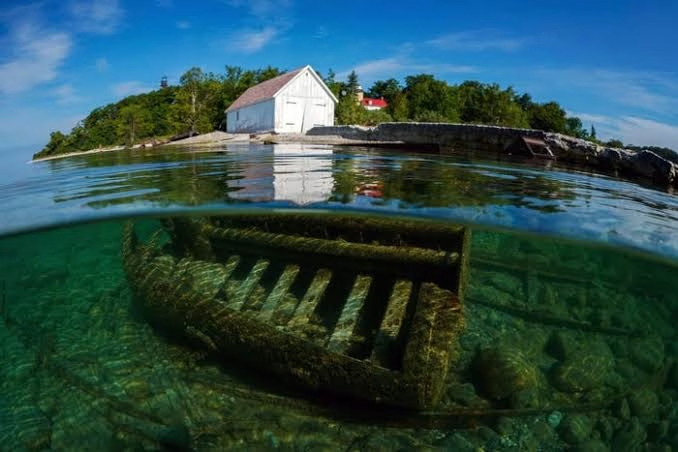
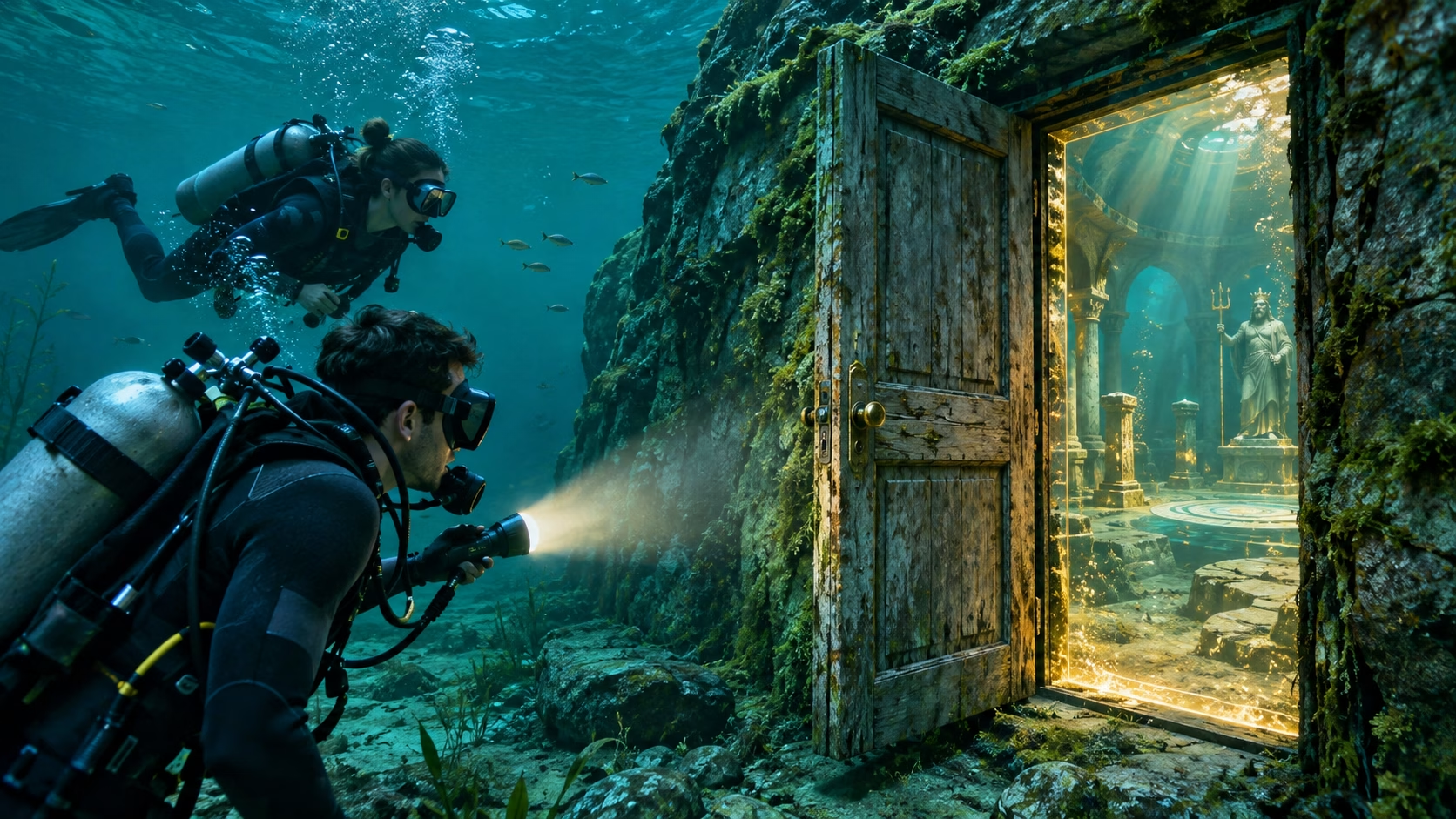
The lake was known for its clear water, peaceful surroundings, and unusually deep central basin.
But during a routine diving expedition, something appeared on the sonar screen that nobody could explain.
A perfectly rectangular shape.
At first, the team assumed it was a submerged shipping container or an old piece of industrial equipment. Lakes often contain forgotten objects, especially in areas where settlements once stood.
But when the divers descended, they discovered something much more unusual.
It looked like a door.
Not a broken piece of wood or a random metal panel. It had a frame, a handle, and what appeared to be a narrow set of steps leading toward it.
And it was standing upright beneath the water.
The Discovery
The expedition was led by an experienced underwater photographer named Ethan.
His team had originally planned to map a section of the lake that had rarely been explored. They carried underwater cameras, sonar equipment, measuring tools, and lights.
The first few hours were uneventful.
Then the sonar operator noticed a shape that looked unusually symmetrical.
They adjusted the equipment and scanned the area again.
The image remained the same.
A rectangular object measuring approximately two metres in height was positioned near the bottom of the lake.
Ethan decided to investigate.
When the divers reached the location, they found the structure partially covered in sediment. Its surface was dark, and the surrounding area contained several large stones.
The most surprising feature was a metal handle attached to its centre.
It looked almost like the entrance to an ordinary building.
What Was Around the Door?
The team began photographing the structure from different angles.
A few metres away, they noticed a second rectangular formation. It appeared to be part of a wall.
As they moved further along the lakebed, more shapes became visible.
There were straight edges, repeated patterns, and what looked like the remains of a narrow pathway.
It was no longer possible to dismiss the discovery as a single abandoned object.
Something had once stood there.
The divers collected photographs and shared their observations with a local historian.
The historian suggested that the lake might have covered an older settlement following a major change in the surrounding landscape.
The idea was plausible. Reservoirs and artificial lakes have submerged roads, buildings, farms, and entire communities in different parts of the world.
But there was a problem.
Nobody could identify a settlement at that exact location.
The Second Expedition
Several weeks later, the team returned with additional equipment.
This time, they focused on mapping the area around the door.
They found what appeared to be a long wall extending beneath the sediment. Near it were several stone structures with unusually straight edges.
One object looked like a window frame.
Another resembled a staircase.
The divers carefully documented everything without attempting to move or disturb the objects.
Ethan later described the experience as strange because the underwater environment made familiar architectural features look completely different.
A doorway that would have seemed ordinary on land felt almost unreal beneath several metres of water.
The Clue Hidden in an Old Map
The historian eventually located an old regional map showing a small settlement near the lake.
The settlement had existed before a major water-management project changed the surrounding landscape.
The map showed several buildings, a road, and a structure near the area where the divers had discovered the door.
It was an important clue.
However, the map did not prove that the underwater structure was part of that particular building.
The team needed more information.
They compared the old map with modern satellite images and underwater measurements. The alignment appeared promising, but the exact identity of the structure remained uncertain.
Was It Really an Entrance?
The most fascinating question was whether the door had ever functioned as an entrance.
Over time, water pressure, sediment, and natural movement could have changed the position of the structure.
It was also possible that what looked like a door was actually part of a larger installation or a decorative architectural feature.
Without a proper archaeological examination, nobody could say for certain.
The divers eventually submitted their photographs and location data to specialists for further assessment.
They did not open the door.
And perhaps that was the most interesting part of the entire discovery.
The team had entered the lake expecting to map an unexplored section of its floor. Instead, they found something that looked like a doorway to a forgotten world.
What once stood above the water might now be hidden beneath it, waiting for someone to understand its history.
For Ethan, the expedition ended with one unanswered question:
If that was the entrance, what did the rest of the building look like before the lake covered it?